The Spray Foam Advice Centre's New Post-Removal Support Programme

For many homeowners, the day their spray foam insulation has finally been removed feels like the end of a long and stressful journey.
After months of dealing with mortgage concerns, survey reports, lender questions, uncertainty and significant financial costs, seeing the roof structure returned to its original condition often brings enormous relief.
But at the Spray Foam Advice Centre, we believe that removal is not the end of the journey.
It is the beginning of the next one.
Over the past few years we have helped thousands of homeowners understand the issues surrounding spray foam insulation. Our role has never simply been to explain the problems. It has always been to guide homeowners through every stage of the process—from understanding the risks, arranging professional removal where appropriate, through to helping them protect both their home and their investment for the future.
That is why we are pleased to introduce our new Post-Removal Support Programme.
Our commitment to homeowners does not stop once the insulation has been removed. In many ways, this is where some of the most important advice begins.
Your Roof Needs to Work Again
Once spray foam has been professionally removed, many homeowners ask the same question:
"What do I do now?"
The answer depends entirely upon your property.
Every roof is different.
Every loft is different.
Every homeowner has different priorities.
Some people simply want their mortgageability restored.
Others want to improve energy efficiency.
Some wish to prepare their property for sale.
Others simply want to ensure they never face this situation again.
Removing the spray foam is only one part of returning your home to good condition.
The next stage is ensuring your roof performs exactly as it was designed to.
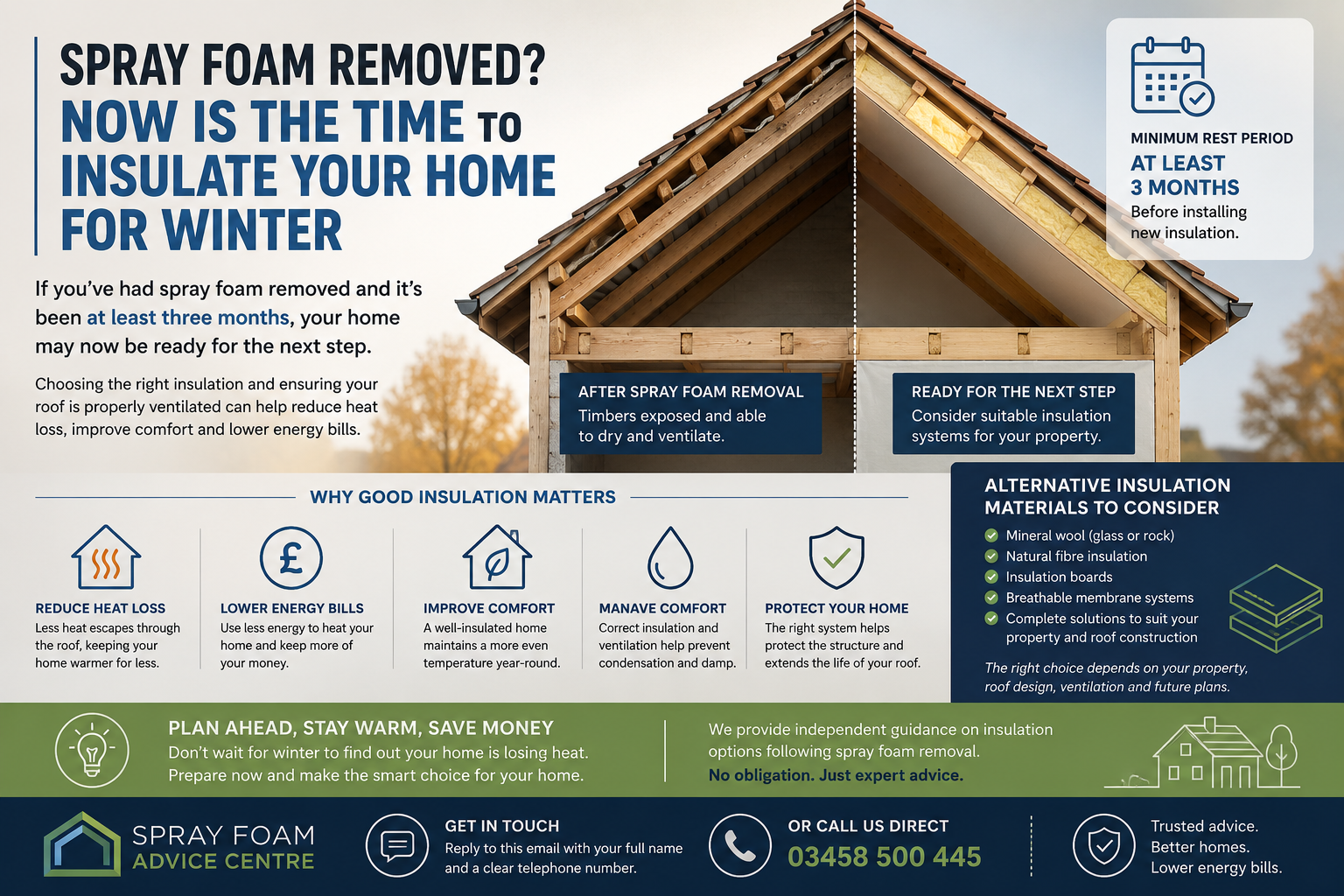
Re-Insulating the Right Way
One of the biggest misconceptions is that once spray foam has been removed, homeowners are left to organise replacement insulation entirely on their own.
That simply isn't the case.
The Spray Foam Advice Centre is now helping previous customers understand the many options available for re-insulating their homes using products that are widely accepted by surveyors, mortgage lenders and building professionals.
Every property is different.
Some homes may benefit from traditional mineral wool insulation.
Others may be suitable for modern breathable systems.
Some properties require additional ventilation improvements.
Others may already meet the required thermal standards after removal.
Our role is not to sell one particular insulation product.
Our role is to help homeowners understand the available options so they can make informed decisions based upon their own property.
Government Funding May Be Available
One of the biggest surprises for many homeowners is discovering that replacement insulation may not necessarily have to be paid for entirely out of their own pocket.
Depending upon individual circumstances, some households may qualify for assistance through Government-backed energy efficiency schemes.
Eligibility depends on numerous factors including:
- Household circumstances
- Income
- Existing insulation levels
- EPC ratings
- Property type
- Existing heating systems
- Current Government funding availability
These schemes change over time and eligibility requirements vary.
However, many homeowners simply do not realise they may qualify.
If you have already removed spray foam insulation through the Spray Foam Advice Centre, our advisers can help explain what schemes may currently be available and whether your property could potentially benefit.
For some households, replacement insulation could cost significantly less than expected.
In certain circumstances, it may even be available with little or no upfront cost where Government funding applies.
Every Home Deserves Individual Advice
One of the reasons we place such emphasis on professional assessments is because there is no universal solution.
The correct recommendation for a Victorian cottage may be entirely different from a modern detached property.
Likewise, recommendations for an older slate roof may differ significantly from those for a modern trussed roof.
Good advice is never one-size-fits-all.
It is based upon understanding the construction of the building, ventilation requirements, moisture control and the condition of the roof after removal.
This is precisely why professional guidance remains so important after the removal process has finished.
We Can Also Help You Understand Section 75 Claims
One area where many homeowners are unaware of their rights concerns Section 75 of the Consumer Credit Act.
If spray foam insulation was purchased using qualifying credit arrangements, some homeowners may have additional legal protection.
Depending upon the individual circumstances, it may be possible to pursue claims relating to losses suffered.
This may include situations where homeowners believe they were misled regarding the suitability of the insulation or the consequences for mortgage lending.
Every case is different.
No outcome can ever be guaranteed.
However, many homeowners are unaware that these protections even exist.
Our advisers can explain how Section 75 works, discuss whether it may apply to your circumstances, and help you understand the claims process.
For some homeowners, successful claims may potentially assist in recovering not only the original installation costs but, in certain circumstances, the costs associated with professionally removing the spray foam insulation as well.
Each claim depends entirely upon the individual facts and supporting evidence.
Professional advice should always be obtained before pursuing any legal claim.
Why Previous Spray Foam Advice Centre Customers Benefit Most
If your insulation removal was arranged through the Spray Foam Advice Centre, we already have a much clearer understanding of your property.
This allows us to provide much more tailored advice.
Our records often include:
- The type of spray foam originally installed
- Whether it was open-cell or closed-cell
- The condition of the roof before removal
- Photographic evidence
- Removal methods used
- Contractor reports
- Recommendations following completion
Having this information enables us to better understand the property's history.
That, in turn, allows us to provide more informed guidance regarding suitable replacement insulation and any future works that may be appropriate.
Why Standards Matter
Removing spray foam insulation correctly is not simply about taking foam off the roof.
The quality of the removal process matters enormously.
Incorrect removal techniques may cause unnecessary damage.
Incomplete removal can leave hidden issues.
Poor cleaning standards may create problems for future inspections.
Damage to roofing felt, battens or timbers can introduce entirely new complications.
This is why the Spray Foam Advice Centre places such importance on recommending companies that operate to strict professional standards.
Our recommended contractors understand what is expected.
They know the documentation required.
They understand why lenders, surveyors and future buyers may request evidence of the work undertaken.
The removal process is about much more than appearance.
It is about restoring confidence in the property.
We Can Still Help Even If We Didn't Arrange Your Removal
Of course, not every homeowner has used one of our recommended contractors.
Many people contact us after arranging removal independently.
We are always happy to help wherever possible.
However, we believe in being completely transparent.
Where we were not involved in the removal process, our ability to assess the quality of the completed work is naturally more limited.
Without:
- Inspection reports
- Before-and-after photographs
- Contractor documentation
- Removal methodology
- Details of materials used
- Completion evidence
it becomes significantly more difficult for us to determine whether the work has been completed to the standards we would normally expect.
That does not mean problems exist.
It simply means our knowledge of the property is more limited.
Our advice therefore has to be based on the information available.
Why We Recommend Trusted Contractors
The Spray Foam Advice Centre has spent years identifying companies capable of carrying out removal work to the standards we expect.
Our recommendations are not based on marketing.
They are based on professionalism.
We expect contractors to demonstrate:
- Appropriate experience
- Safe working practices
- Proper documentation
- Transparent communication
- High-quality workmanship
- Respect for homeowners
- Clear photographic evidence
- Professional completion records
These standards are designed to protect homeowners long after the work has been completed.
Our Commitment Doesn't End When the Foam Has Gone
One of the biggest frustrations many homeowners express is feeling abandoned once the removal work has finished.
That is not how we believe customer support should work.
Our goal has always been to support homeowners through the entire process.
That includes helping them understand:
- Future insulation options
- Ventilation improvements
- Mortgage considerations
- Property sales
- Surveyor questions
- Insurance concerns
- Potential financial recovery
- Government funding opportunities
We see removal as one stage of restoring confidence in your home—not the final chapter.
Looking to the Future
The conversation surrounding spray foam insulation continues to evolve.
Government guidance changes.
Funding schemes change.
Mortgage lending criteria change.
Building products continue to develop.
New insulation technologies become available.
Our advisers remain committed to helping homeowners understand these changes as they occur.
The information available today may differ from that available six months from now.
That is another reason why ongoing support is so valuable.
Why Contact the Spray Foam Advice Centre Again?
If we previously helped you remove spray foam insulation, now is the perfect time to get back in touch.
We may be able to help you explore:
- Replacement insulation options.
- Government-funded energy efficiency schemes.
- Ways to improve your home's thermal performance.
- Guidance on Section 75 claims where appropriate.
- The next steps following professional removal.
- Documentation that may assist with future surveys or mortgage applications.
Even if your removal was completed some time ago, it is worth asking what support may now be available.
We're Still Here to Help
Our mission has always been simple.
To provide independent, practical guidance that helps homeowners make informed decisions.
Removing problematic spray foam insulation is a major milestone—but it should never be the end of the conversation.
Whether you are looking to restore your home's energy efficiency, explore Government-backed insulation schemes, understand your rights under Section 75, or simply want reassurance that you are taking the right next steps, the Spray Foam Advice Centre is here to help.
If we managed your insulation removal, we already have valuable knowledge about your property that enables us to offer more tailored guidance.
If your removal was carried out elsewhere, we will still do our best to assist, while being honest about the limitations of the information available to us.
Above all, our commitment remains unchanged.
We are here not only to help homeowners remove problematic spray foam insulation—but to help them move forward with confidence, restore their homes to the highest possible standards, and make informed decisions that protect both their property and their future.
Share this article