Cold Callers Are Back — This Time They're Claiming Your Spray Foam Removal Needs "Checking"
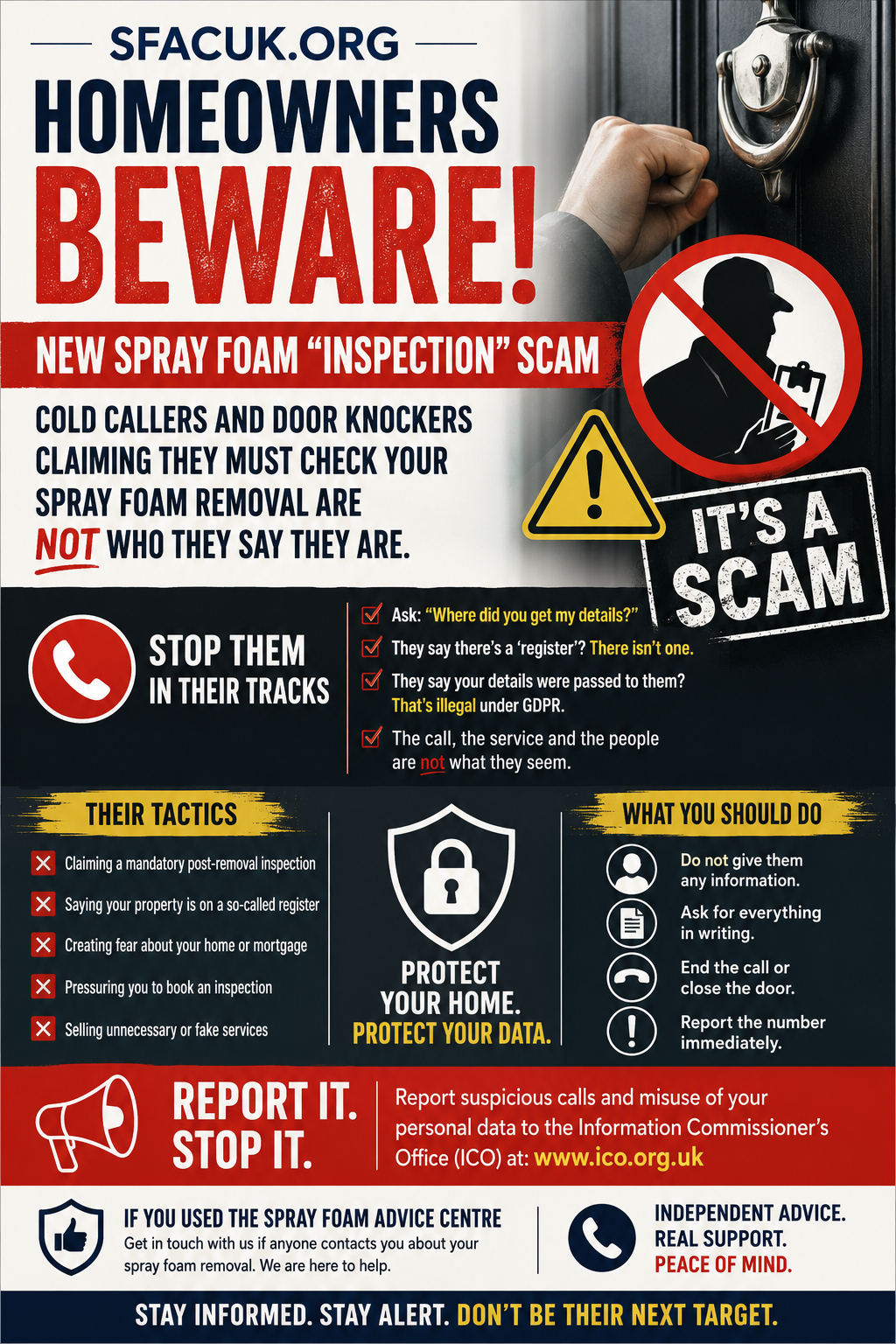
Over the past several months, the Spray Foam Advice Centre has become aware of an increasing number of reports from homeowners receiving unsolicited telephone calls, emails and even doorstep visits from companies claiming they need to "inspect" or "certify" previously removed spray foam insulation.
These callers often present themselves as being part of an industry scheme, a compliance programme, or a register that supposedly requires your property to be checked to ensure the removal was completed correctly.
This should immediately raise alarm bells.
In the overwhelming majority of cases reported to us, these approaches appear to follow a familiar pattern used by rogue traders—creating uncertainty and fear in order to persuade homeowners to purchase unnecessary services.
If someone contacts you unexpectedly claiming your spray foam removal now requires a mandatory inspection, verification or certification, treat the approach with extreme caution.
There Is No National Register That Requires Post-Removal Checks
One of the most common claims being reported is:
"We've been instructed to contact homeowners who have had spray foam removed."
Or:
"Your property has appeared on our register."
Or:
"We're carrying out mandatory post-removal compliance inspections."
These statements are often designed to sound official.
To our knowledge, there is no general national register that requires homeowners to arrange a routine post-removal inspection simply because spray foam insulation has been removed.
If someone tells you that your name appears on a mysterious register that now requires action, ask them one very simple question:
"Which register?"
Ask for its official name.
Ask who operates it.
Ask for the website.
Ask for the legislation that requires it.
If they cannot clearly answer those questions, you should end the conversation.
The First Question You Should Always Ask
Whenever you receive one of these calls, ask:
"Where did you obtain my personal details?"
This is one of the most important questions you can ask.
Legitimate organisations should be able to explain where your information came from.
If they refuse to answer...
If they become evasive...
If they provide vague explanations...
...that should concern you.
"Your Details Were Passed To Us"
Another explanation homeowners tell us they are hearing is:
"Your installer passed your details to us."
Or:
"We work with another company."
Or:
"Your file has been transferred."
Be extremely cautious.
Organisations handling personal information must have a lawful basis for processing and sharing personal data.
Personal information cannot simply be passed from one company to another because it may be commercially useful.
If somebody claims your details were supplied by another business, ask them:
- Which company?
- When?
- Under what authority?
- What lawful basis do you rely upon for holding my data?
If they cannot provide a clear explanation, you should seriously question why they are contacting you.
Fear Is Their Sales Tool
Many of these approaches appear to rely upon creating anxiety.
Typical statements reported by homeowners include:
- "The removal may not have been completed correctly."
- "Your roof could still have problems."
- "You need a compliance inspection."
- "Your mortgage could still be affected."
- "You need certification."
The objective is simple.
Create uncertainty.
Create urgency.
Sell an inspection.
Potentially sell additional work.
This style of marketing has existed for decades across many industries.
Spray foam is simply the latest sector where some homeowners report experiencing these tactics.
The Same Pattern We Have Seen Before
The spray foam industry has already experienced years of aggressive marketing, misleading sales practices and high-pressure selling by some businesses.
Now that many homeowners are removing spray foam insulation, it appears that some individuals may simply have shifted to selling the next service.
Instead of selling installation...
They now appear to be selling inspections.
Instead of creating fear about heat loss...
The concern is now whether removal was "completed correctly."
The wording has changed.
The sales tactic often feels very familiar.
Genuine Professionals Do Not Need To Cold Call
Professional businesses generally build their reputation through quality work, referrals and transparent communication.
Unexpected cold calls claiming that urgent inspections are required should always be approached carefully.
If somebody genuinely believes there is a specific issue affecting your property, they should be able to explain:
- Why they are contacting you.
- Where they obtained your details.
- Why they believe your property specifically requires attention.
- What evidence supports their concerns.
If none of that information is available, there is every reason to be cautious.
If They Turn Up At Your Door
Some homeowners have also reported unexpected doorstep visits.
Remember:
You are under absolutely no obligation to allow anyone into your property simply because they claim to be carrying out inspections.
Before allowing anyone access, ask for:
- Company identification.
- Contact details.
- The reason for the visit.
- Written documentation.
- Evidence explaining why your property has been selected.
If you remain unsure...
Do not allow access.
Take time to verify who they are.
Protect Your Personal Information
Never provide information simply because somebody already appears to know something about your property.
Fraudsters sometimes possess partial information.
That does not make them legitimate.
Do not confirm:
- Your address.
- Previous removal dates.
- Payment details.
- Mortgage information.
- Personal financial circumstances.
Every answer you give may help build a more detailed picture of your situation.
Report Suspicious Calls
If you believe you have received an unsolicited marketing call or your personal information may have been used improperly, consider reporting the matter to the relevant authorities.
Where appropriate, reports about suspected breaches of UK data protection or unsolicited direct marketing can be made to the Information Commissioner's Office (ICO).
Keeping a record can also be helpful, including:
- The telephone number used.
- The company name provided.
- The date and time of the call.
- What was said.
- Any emails or text messages received.
Even if no immediate action is taken, reports help identify patterns of behaviour.
If You Used the Spray Foam Advice Centre
If your spray foam removal was arranged through the Spray Foam Advice Centre, you should already have documentation relating to your project.
If someone contacts you claiming that further inspections are suddenly required, we recommend contacting us directly before agreeing to anything.
We can help you understand whether the approach appears genuine or whether it raises concerns.
Do not feel pressured into making immediate decisions simply because somebody contacts you unexpectedly.
If You Didn't Use Our Service
Even if your removal was completed by another company, we are still happy to provide general guidance where we can.
However, we may not have access to the documentation relating to your removal project, which naturally limits what we can comment on.
That is another reason why retaining your paperwork remains important.
Remember These Simple Rules
If somebody unexpectedly contacts you regarding previously removed spray foam insulation:
✔ Ask where they obtained your personal details.
✔ Ask why they are contacting you.
✔ Ask who authorised them to contact you.
✔ Ask for everything in writing.
✔ Never agree to inspections during the first call.
✔ Never feel pressured into making immediate decisions.
✔ Keep records of any suspicious contact.
✔ Report unsolicited marketing or suspected misuse of your personal information where appropriate.
Stay Alert. Stay Informed.
The vast majority of homeowners simply want peace of mind after dealing with the stress and expense of spray foam removal.
Unfortunately, where uncertainty exists, there will sometimes be individuals looking to exploit it.
Being contacted unexpectedly does not automatically mean a business is acting improperly—but it does mean you should ask questions, verify who they are, and avoid making decisions under pressure.
At the Spray Foam Advice Centre, we believe informed homeowners are protected homeowners.
If you receive an unexpected call claiming your spray foam removal now requires an urgent inspection, mandatory check or special certification, take a moment before agreeing to anything.
Ask questions.
Request evidence.
Verify independently.
And if something doesn't feel right, trust your instincts and seek independent advice before proceeding.
Knowledge remains your strongest defence against misleading sales tactics.
Share this article