Removing Spray Foam Doesn't Remove the Need for Insulation
For many homeowners who have had spray foam insulation removed from their roof, the immediate priority afterwards is quite rightly to allow the roof structure time to breathe, dry and settle.
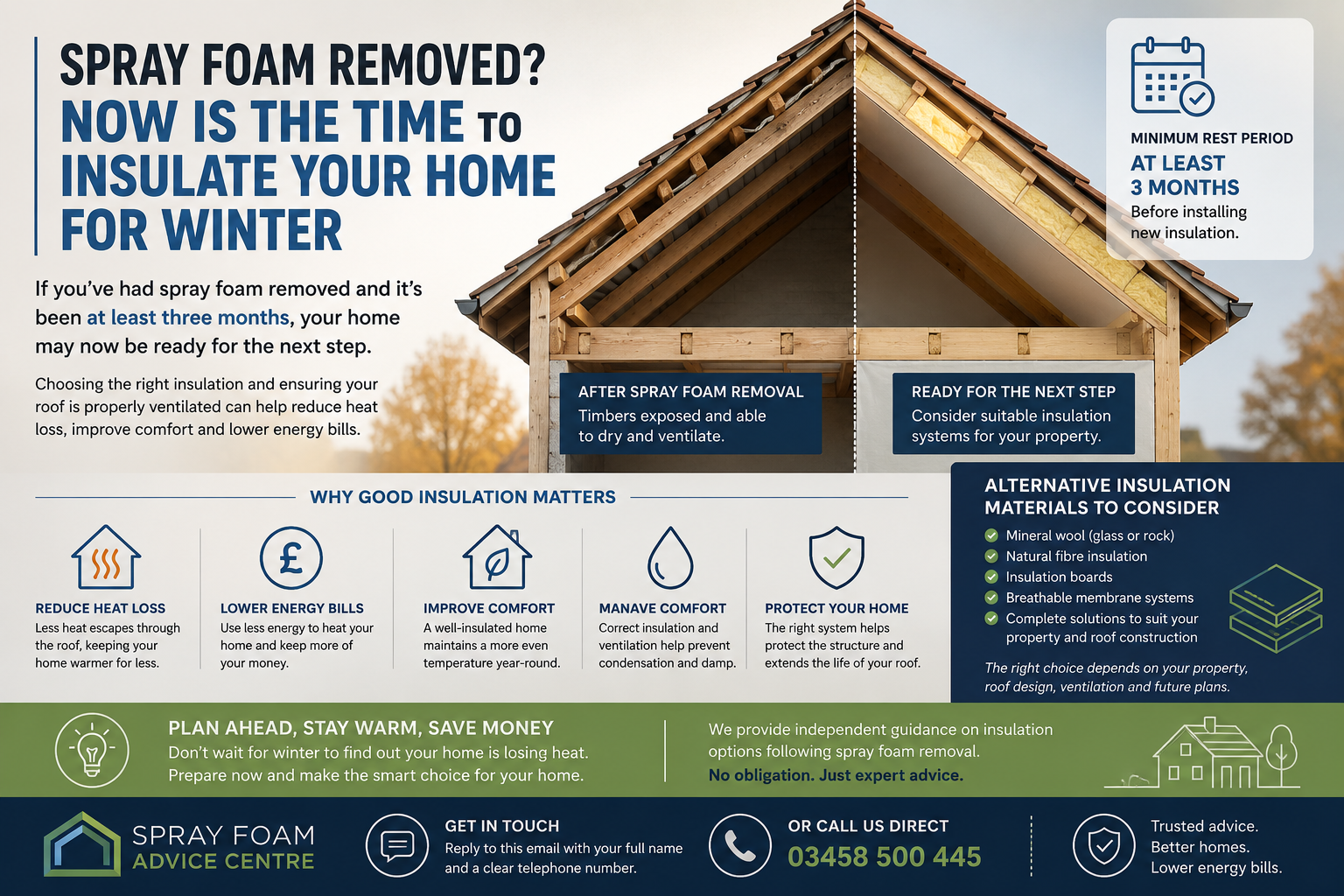
At the Spray Foam Advice Centre, we generally advise allowing an appropriate period following removal before considering replacement insulation. Where the roof timbers are dry and there are no outstanding moisture, ventilation or structural concerns, homeowners who have now passed a rest period of at least three months may want to start thinking about the next stage: how their home should be insulated going forward.
With autumn approaching, this is a sensible time to have that conversation.
This isn't about rushing into another insulation product. It is about understanding the property, choosing the right materials and making sure that money spent on heating this winter isn't unnecessarily disappearing through a poorly insulated home.
Removing Spray Foam Doesn't Remove the Need for Insulation
One of the understandable consequences of the problems surrounding spray foam is that some homeowners become nervous about insulation altogether.
But spray foam and insulation are not the same thing.
A property still needs to manage heat loss effectively. Once spray foam has been removed, the objective should be to return the roof to a condition where it can be properly inspected and then consider an insulation system that is appropriate for the construction and ventilation requirements of the property.
There are a number of more conventional insulation materials and systems available, and the right solution will depend on factors including the type and age of the property, existing ventilation, roof construction and where the thermal envelope of the home is intended to sit.
There is no single product that is automatically right for every house.
Why We Recommend a Period After Spray Foam Removal
At the Spray Foam Advice Centre, we do not generally encourage homeowners to remove spray foam one week and immediately install replacement insulation the next.
Allowing a suitable period after removal can be valuable.
It provides an opportunity for previously covered roof timbers to remain exposed and ventilated and allows any concerns identified during or following the removal process to be investigated before another insulation system is introduced.
For many homeowners, three months is an important minimum point at which to begin reviewing the next stage, although individual properties may require longer.
The condition of the property should ultimately determine when it is appropriate to proceed.
Don't Wait Until the Cold Weather Arrives
One of the most common mistakes with energy-efficiency improvements is waiting until the house feels cold before doing anything about it.
By then, installers can become busier, suitable products may have longer lead times and the household is already paying to heat a property that may be losing energy unnecessarily.
Late summer and early autumn provide an opportunity to look at the property before those colder months arrive.
That means asking some simple questions:
Is the loft currently insulated adequately? Is the existing insulation in good condition? Is ventilation working correctly? Are there obvious areas of heat loss? And, most importantly, what insulation system is appropriate for the way the property has actually been constructed?
These are better questions to answer now than halfway through winter.
Energy Efficiency Is About Keeping the Heat You Have Already Paid For
There is understandably a great deal of discussion about energy prices and household bills.
Homeowners cannot control wholesale energy markets, future government policy or the weather. What they can potentially improve is how efficiently their own property uses the energy they purchase.
Heating a home costs money. If a significant proportion of that heat is being lost through inadequately insulated parts of the building, more energy is required to maintain a comfortable temperature.
Good insulation is therefore not simply about making a house warmer.
It is about reducing unnecessary heat loss and making better use of the energy you are already paying for.
That becomes increasingly important when household budgets are under pressure and future energy costs remain difficult to predict.
What Can Replace Spray Foam?
There are several established insulation materials and systems that may be suitable following spray foam removal.
The correct choice depends on the individual property.
Rather than recommending that homeowners simply purchase a particular product, we believe the starting point should be an assessment of what the building actually requires.
That can include looking at conventional loft insulation products, mineral-based insulation materials, suitable insulation boards and other established systems depending upon the construction and intended application.
Just as importantly, insulation should be considered alongside ventilation and moisture management.
Installing more insulation is not necessarily the same thing as improving a property.
The objective is to create the right balance between insulation, ventilation and the existing construction of the home.
Be Careful About Replacing One Problem With Another
Homeowners who have already paid to have spray foam removed understandably do not want to find themselves facing another expensive problem several years from now.
That is why we encourage people to take their time and understand what is being proposed.
Before agreeing to replacement insulation, homeowners should be comfortable asking:
What material is being installed?
Where will it be installed?
How will ventilation be maintained?
Is it appropriate for this particular roof or property?
What documentation will be provided when the work is completed?
A reputable insulation company should be comfortable answering those questions.
Preparing Your Home Before Winter
The months before winter are a good opportunity to review the overall energy efficiency of the property rather than concentrating solely on one product.
Loft insulation is only one part of the picture.
Existing insulation levels, ventilation, draughts and other areas of potential heat loss can all influence how effectively a home retains heat.
For homeowners who have recently had spray foam removed, however, the roof and loft are an obvious place to begin.
If your property has now had an appropriate period following removal, this may be the right time to have the loft reviewed and understand the options available before deciding whether further work is required.
Independent Guidance Before Making a Decision
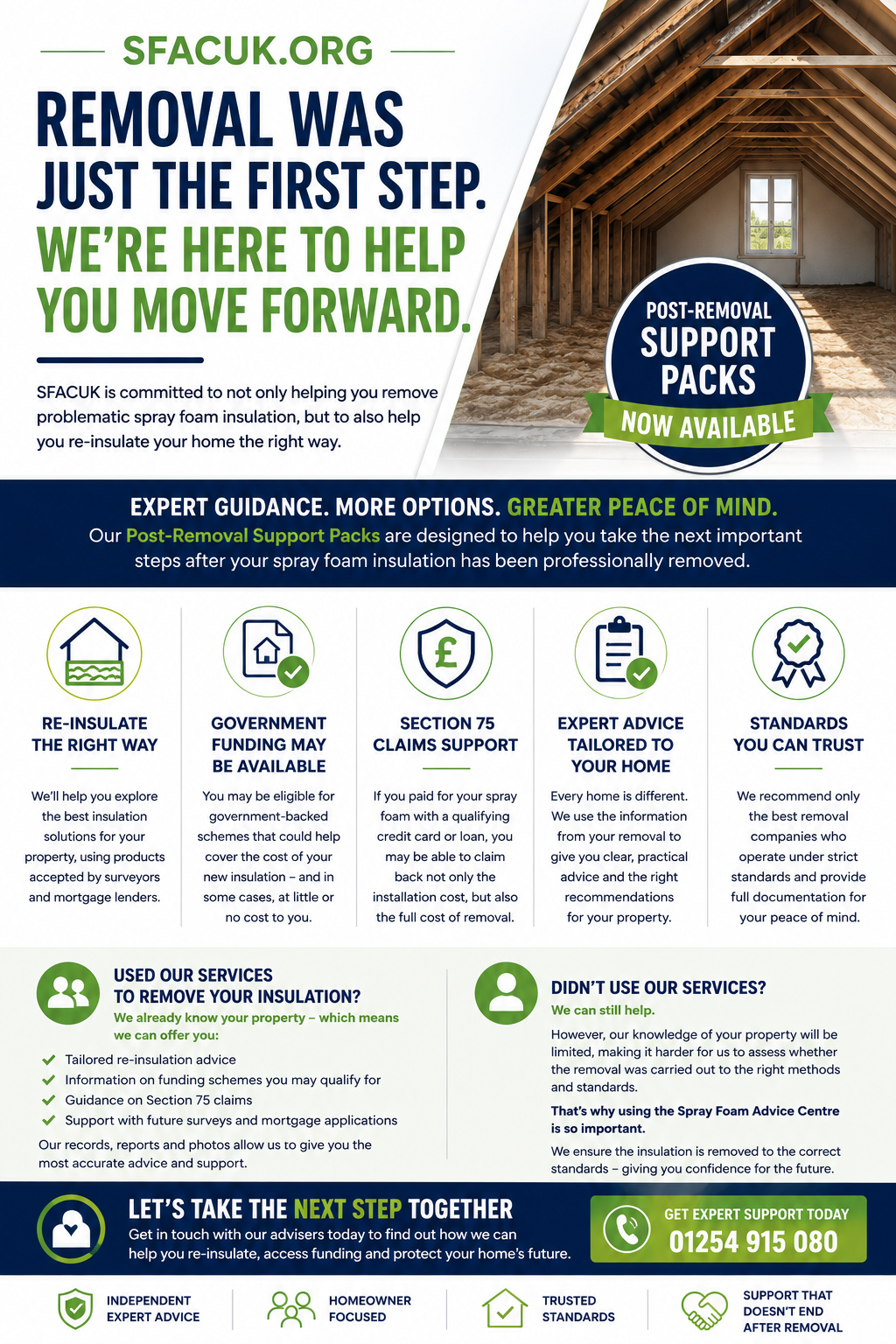
The Spray Foam Advice Centre is working with companies within the insulation and home-improvement sector to help homeowners understand suitable options following spray foam removal.
Our role is to help homeowners make an informed decision rather than simply replacing one insulation product with another without understanding the consequences.
We currently have access to preferential arrangements and discounts through recommended companies working with us, although availability is limited and will depend upon the property, location and work required.
If you have had spray foam removed and have now completed a rest period of at least three months, you are welcome to speak with us about the next stage.
There is no obligation to proceed with work.
The important thing is to understand what your property needs and, if improvements are appropriate, to plan them before the colder weather arrives.
Speak to the Spray Foam Advice Centre
If you would like to discuss insulation following spray foam removal, or simply want to understand what options may be suitable for improving the energy efficiency of your property before winter, please contact us.
You can reply to this email with your full name and a clear telephone number, together with a brief description of your property and when the spray foam was removed. A member of the team can then contact you to discuss your circumstances.
Alternatively, call the Spray Foam Advice Centre directly on 03458 500 445.
Discounted arrangements may currently be available through companies working with us, but these are not unlimited.
The objective is not to rush homeowners into another insulation decision.
It is to make sure that, after going through the process of removing spray foam, the next decision is a considered one — helping to create a home that is properly insulated, appropriately ventilated and better prepared for the winters ahead.
Prepare the property before the cold arrives — rather than waiting for the energy bills to tell you there is a problem.
Spray Foam Advice Centre — Independent guidance for homeowners dealing with spray foam insulation, removal and the next steps for their property.
Share this article