A warning to homeowners planning to sell, remortgage or remove spray foam insulation in the New Year: changes to VAT relief, contractor registration requirements and increasing demand for specialist removal services could make delaying your decision an expensive mistake.

At the Spray Foam Advice Centre, we are encouraging homeowners who already know their spray foam insulation needs to be removed to start making arrangements before the end of 2026.
If you are thinking, "I'll deal with it after Christmas," we believe there are some important financial considerations you should understand first.
Our advice is simple: don't wait until January to discover that the cost of dealing with your spray foam may have changed.
You do not necessarily need to have the work completed before Christmas. But getting professional advice, understanding the costs, obtaining quotations and making arrangements now could put you in a much better position as we approach 2027.
Why Are We Encouraging Homeowners to Act Now?
Three important factors are coming together.
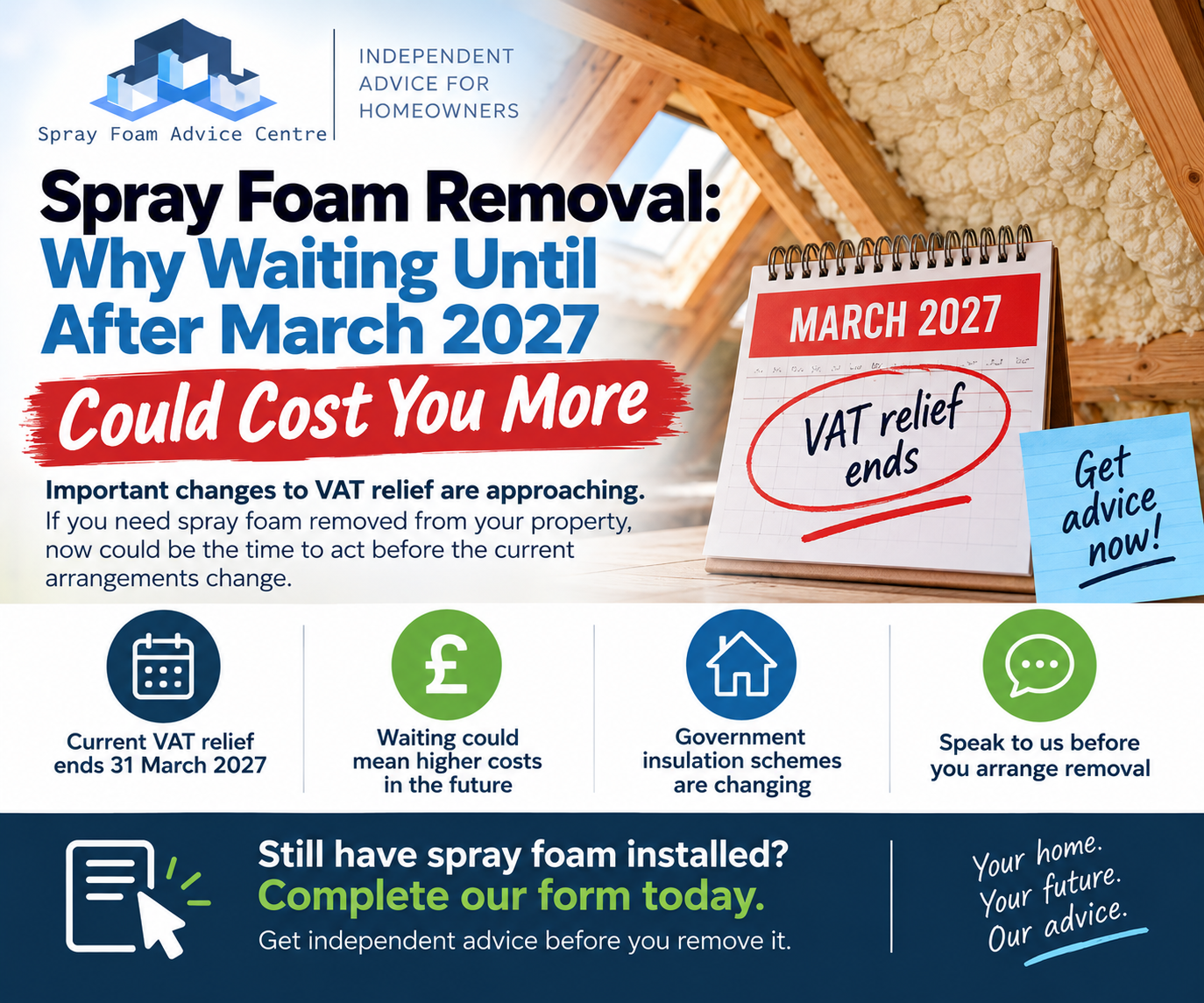
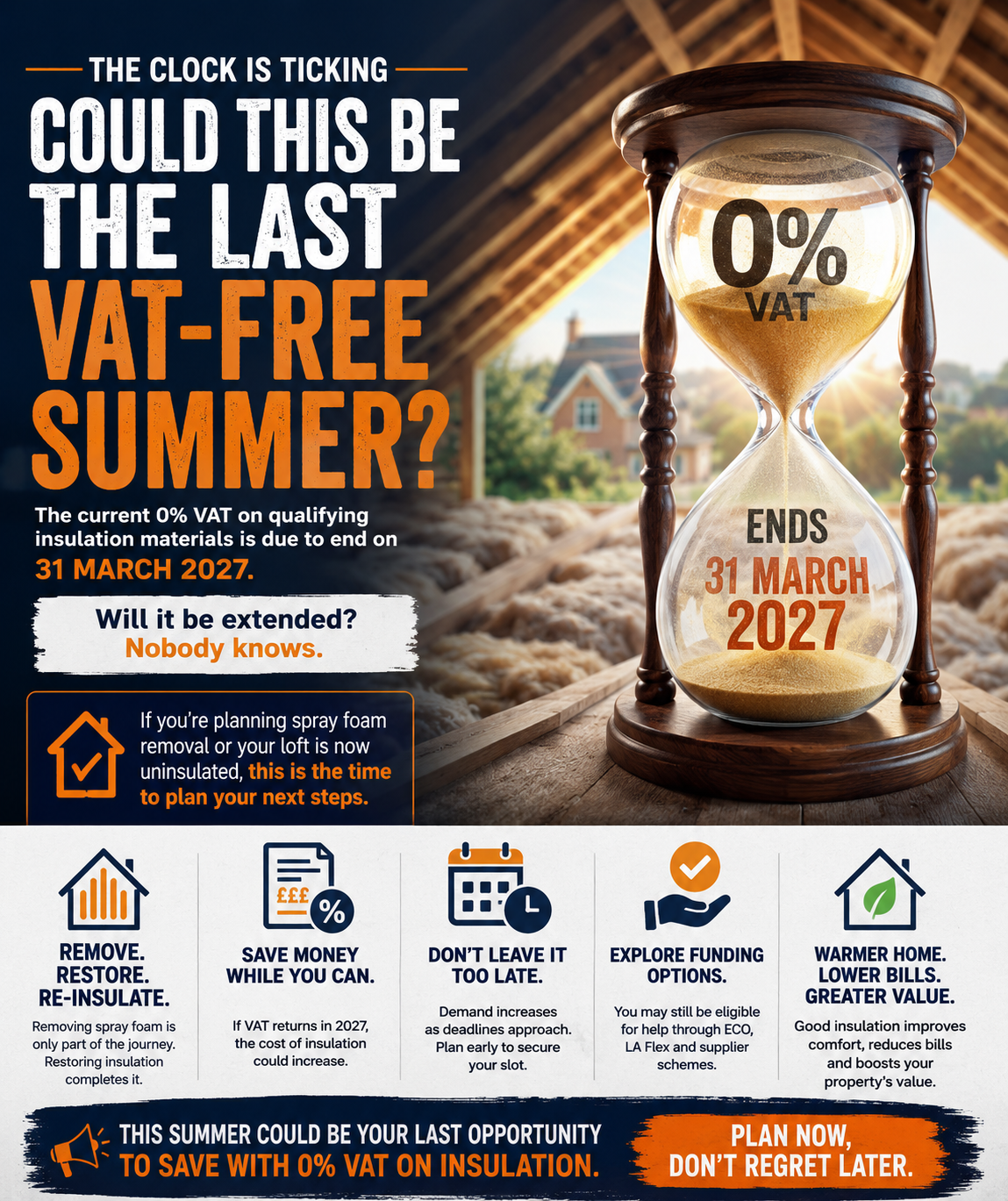
Firstly, the Government has confirmed that the temporary zero-rate VAT relief on qualifying energy-saving material installations will end on 31 March 2027.
Secondly, specialist spray foam removal can be expensive, and smaller contractors may become required to register for VAT as their businesses grow.
Thirdly, we anticipate that January and February could become particularly busy months for homeowners trying to arrange removal and replacement insulation before the March deadline.
These factors do not mean every removal quotation will increase. However, they create genuine uncertainty for homeowners who leave necessary work until the last minute.
If you are planning to sell your home in early 2027, now is the time to understand your options.
How Did We Arrive at the March 2027 Deadline?
In April 2022, the Government introduced temporary zero-rate VAT relief for the installation of qualifying energy-saving materials in residential properties.
The purpose was to make certain energy-efficiency improvements more affordable and encourage homeowners to invest in reducing heat loss and energy consumption.
This included qualifying insulation installations.
The arrangements were subsequently extended to Northern Ireland from May 2023, with further changes introduced in February 2024.
However, the relief was always intended to be temporary.
The Government's 2026 Budget has confirmed that the current zero-rate arrangements will end on 31 March 2027, with qualifying installations returning to the reduced VAT rate from April.
For homeowners who are considering having unsuitable spray foam removed and appropriate replacement insulation installed, this is an important date.
But there is another aspect of the VAT rules that we believe deserves much greater attention.
Spray Foam Removal Is Not Necessarily an Energy-Efficiency Installation
This is where homeowners need to be particularly careful.
There is an important difference between installing insulation to improve a property's energy efficiency and removing insulation that is already present.
Under HMRC guidance, the temporary VAT relief applies to qualifying installations of energy-saving materials.
Simply removing existing spray foam insulation does not, by itself, qualify as installing an energy-saving material.
A contractor removing unwanted spray foam may be providing a specialist removal service rather than carrying out a qualifying energy-efficiency installation.
Where that removal is supplied as a separate, standard-rated service by a VAT-registered business, the normal VAT rate may apply.
The position can be different where removal work is genuinely ancillary to a qualifying installation of replacement insulation. In such cases, the correct VAT treatment depends on the nature of the overall supply.
This is why homeowners should not automatically assume that a spray foam removal quotation qualifies for zero-rated VAT.
Our advice is to ask the contractor to explain the VAT treatment in writing before signing any agreement.
The £90,000 VAT Threshold: Why Removal Companies Could Be Affected
Another important consideration is the VAT registration threshold.
Under current HMRC rules, businesses generally become required to register for VAT when their taxable turnover exceeds £90,000 over a rolling 12-month period.
That figure may sound substantial, but consider the cost of specialist spray foam removal.
Some projects can cost around £5,000.
At that price, a contractor completing just 19 jobs would generate £95,000 in turnover.
That is enough to exceed the current VAT registration threshold, assuming the turnover is taxable.
For a busy removal company, reaching this level of turnover may not take long.
And once a business becomes VAT-registered, it must account for VAT on taxable services at the applicable rate.
This does not mean that every removal company will become VAT-registered in January or that every customer will automatically face a higher bill.
But it does mean that a smaller contractor's VAT position can change as the business grows.
Homeowners should be aware that a quotation obtained from a contractor today may not necessarily be the same as a quotation offered several months later.
Could a £5,000 Removal Become More Expensive?
Consider a straightforward example.
A homeowner obtains a quotation of £5,000 from a contractor who is not currently required to charge VAT.
If that contractor subsequently becomes VAT-registered and the removal service is standard-rated, a new quotation at the same underlying price could amount to £6,000 including VAT.
That represents an additional £1,000.
This is an illustration, not a prediction. The actual outcome would depend on the contractor's pricing, registration status, contract terms and the VAT treatment of the work.
Nevertheless, it demonstrates why VAT should be an important consideration when obtaining quotations for expensive removal projects.
We believe homeowners should establish the total price, including any applicable VAT, before committing to work.
Planning to Sell Your Home After Christmas?
For homeowners planning to sell or remortgage in early 2027, delaying necessary spray foam removal could create additional complications.
We regularly hear from people whose property transactions have been affected by spray foam insulation.
Some have been advised that removal is necessary before a lender will proceed.
Others have encountered concerns during surveys or valuations.
If you are hoping to sell in January, February or March, leaving everything until after Christmas may put you under unnecessary pressure.
Contractors need time to assess properties, prepare quotations, arrange appointments and carry out the work safely.
Where roof repairs or replacement insulation are also required, the process can become more involved.
We anticipate that demand for appointments could be particularly strong during the first months of 2027.
Rather than waiting, we recommend starting the process now.
Can Booking Before March Protect You From Additional VAT?
It is worth making an important distinction.
Obtaining a quotation and signing a contract before the March deadline does not automatically guarantee that the work will qualify for zero-rated VAT.
VAT rules take account of the nature of the service and the relevant tax point, which can depend on when work is performed, invoiced or paid for.
Nevertheless, arranging work early gives homeowners an opportunity to establish the correct VAT treatment, understand their total costs and agree contractual terms before committing.
We recommend asking for written confirmation of the price, the VAT position, the proposed work and the agreed schedule.
Do not rely on verbal promises that a particular VAT rate will apply simply because you booked early.
Before You Remove Your Spray Foam, There Is Something Else You Should Know
At the Spray Foam Advice Centre, we believe the most important financial consideration may not be VAT at all.
It may be whether you have options to recover the money you originally paid for the spray foam installation and the cost of having it removed.
We regularly speak to homeowners who believe they have no choice but to pay thousands of pounds to remove a product they previously paid thousands to install.
But depending upon the circumstances of the original sale, installation and payment arrangements, there may be avenues available for seeking recovery of those costs.
We have helped homeowners understand the appropriate steps to take before removal, including cases where homeowners have subsequently recovered both their installation and removal costs.
Every case is different, and financial recovery cannot be guaranteed.
However, the timing of your actions can be important.
Before you pay a contractor to remove your spray foam, speak to the Spray Foam Advice Centre.
Why Your Spray Foam Must Still Be Installed
Our particular pre-removal advice service is intended for homeowners who still have spray foam insulation installed in their property.
The original installation may contain important evidence relevant to the circumstances of a potential claim.
Once the foam has been removed and disposed of, that evidence may become difficult or impossible to examine.
That is why we encourage homeowners to obtain advice before arranging removal.
If your spray foam has already been removed, unfortunately we cannot assist through this particular pre-removal service.
Our Final Advice for 2026: Don't Leave Everything Until the New Year
With Christmas approaching and the March 2027 VAT deadline drawing closer, we believe this is an important time for homeowners to review their plans.
If your spray foam is causing mortgage difficulties, delaying a property sale or has already been assessed as requiring removal, don't simply put the problem aside until January.
You can take sensible steps now.
Obtain independent advice.
Understand the removal process.
Establish whether you may have options for recovering your costs.
Request written quotations and confirm the VAT treatment.
And consider arranging an appropriate removal date before the expected New Year demand.
The important thing is not to rush into removal. It is to avoid unnecessary delay in getting the right advice.
Still Have Spray Foam Installed? Make Your Enquiry Before Christmas
If you are planning spray foam removal in early 2027, we encourage you to contact the Spray Foam Advice Centre now.
Our team can discuss your circumstances, explain the considerations before removal and help you understand the potential options available.
You may have paid thousands to have your spray foam installed.
You may now be facing thousands more to remove it.
And delaying the process could introduce further costs or complications.
Before you pay again, find out what options you have.
DON'T WAIT UNTIL JANUARY TO START ASKING QUESTIONS.
Complete our online enquiry form today and allow one of our advisers to contact you.
Spray Foam Advice Centre — Independent advice for UK homeowners.
Share this article