If you've had spray foam insulation removed from your property, or are considering removal, you may be wondering what comes next. How can you keep your home warm, improve energy efficiency and avoid making another expensive insulation mistake?
At the Spray Foam Advice Centre, we regularly speak to homeowners who originally invested in spray foam insulation because they wanted a warmer, more energy-efficient property.
Unfortunately, some have subsequently encountered difficulties with mortgages, property sales, roof inspections or concerns about the suitability of their installation.
When removal becomes necessary, one of the most common questions we hear is:
"What can I replace my spray foam with that will actually work?"
There are several established insulation systems worth considering, including traditional mineral wool and modern reflective insulation products.
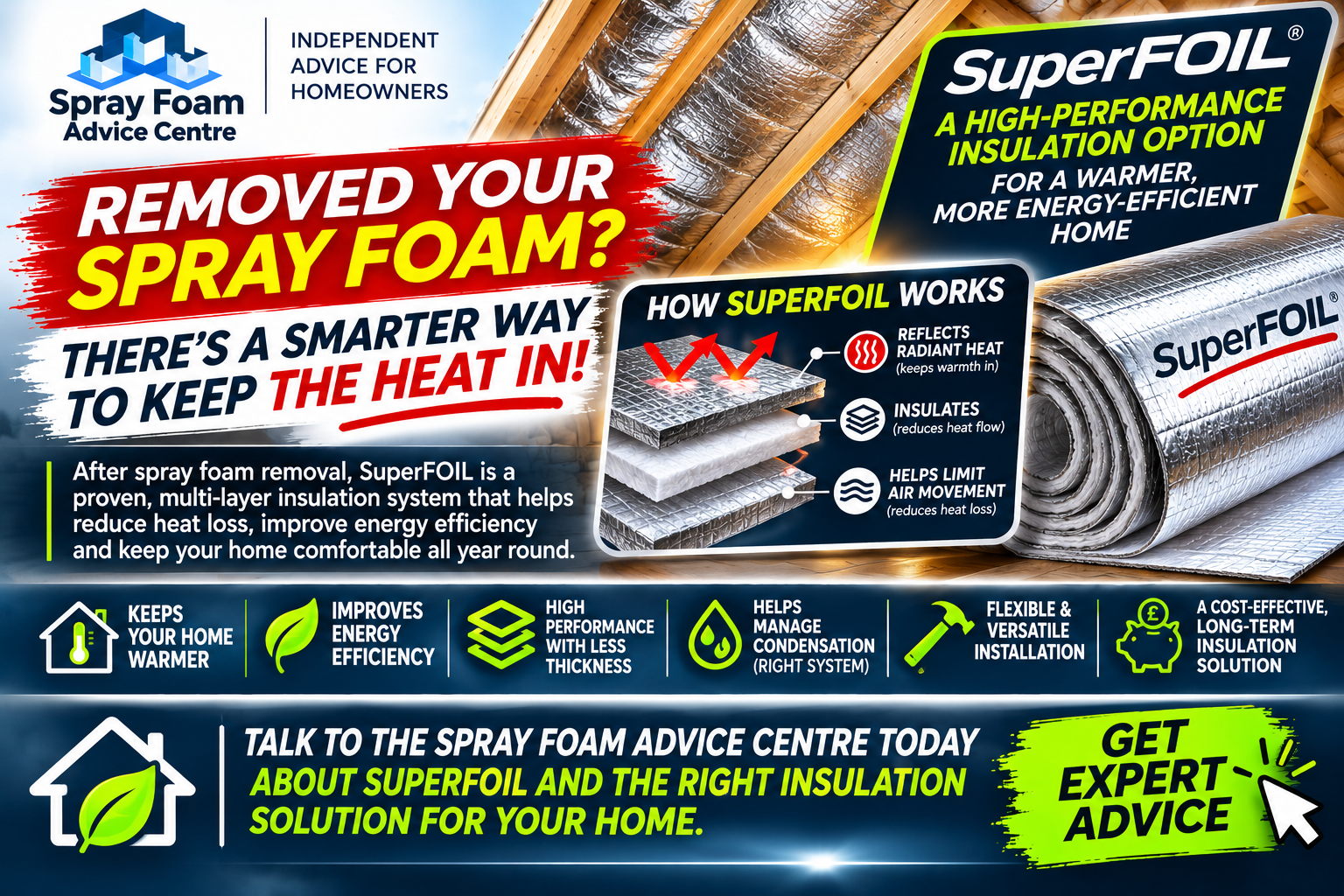
One option we believe deserves serious consideration is SuperFOIL multi-layer insulation.
But what exactly is it, how does it work, and why might it be suitable for your home?
What Is SuperFOIL Insulation?
SuperFOIL is a type of multi-layer reflective insulation, sometimes referred to as multifoil insulation.
Unlike traditional insulation products that rely primarily on thick layers of mineral fibres or rigid foam, SuperFOIL combines multiple layers of reflective foil with insulating wadding.
These layers are designed to reduce the movement of heat through the building.
The product is supplied in flexible rolls and can be installed in various roof, wall and floor applications, depending on the specific product and the construction of the property.
One of its main attractions is that it can provide useful thermal performance without necessarily requiring the same thickness as some conventional insulation systems.
For homeowners who have recently removed spray foam, this flexibility can make it an interesting alternative.
How Does SuperFOIL Actually Work?
To understand why reflective insulation can be effective, it helps to understand how heat escapes from a building.
Heat moves in three principal ways.
1. Conduction — Heat Moving Through Materials
Heat can travel through solid materials such as roof timbers, walls and ceilings.
Insulating layers help slow this transfer.
SuperFOIL contains layers of insulating material designed to resist heat flow through the product.
2. Convection — Heat Moving Through Air
Warm air rises and moves around a building.
Uncontrolled air movement through gaps in the building fabric can contribute to heat loss.
When an appropriate SuperFOIL system is installed with properly sealed joints, it can help reduce unwanted air leakage.
However, this should never be confused with blocking the ventilation that a roof structure needs.
3. Radiation — Heat Transferring Between Surfaces
This is where reflective insulation offers an additional benefit.
Warm surfaces emit infrared radiation.
SuperFOIL uses reflective, low-emissivity surfaces to reduce radiant heat transfer across adjacent air spaces.
During colder weather, this can contribute to reducing heat loss.
During warmer weather, a correctly designed reflective insulation system can also help limit unwanted heat gain.
The important point is that SuperFOIL combines insulating layers with reflective surfaces to address several mechanisms of heat transfer.
Its performance depends on the complete installation, including any required air gaps.
Why Do We Consider SuperFOIL a Plausible Alternative to Spray Foam?
At the Spray Foam Advice Centre, our primary concern is helping homeowners choose insulation that is suitable for their property.
We do not believe there is one insulation product that is automatically the best solution for every home.
However, SuperFOIL offers several characteristics that make it worth considering.
A Flexible Insulation System
SuperFOIL is supplied in rolls and can be fitted across suitable roof structures.
Depending on the installation design, this may allow a continuous insulation layer to be created across the rafters, helping to reduce thermal bridging.
Useful Thermal Performance in Limited Space
Some SuperFOIL systems can achieve significant thermal resistance without requiring the same depth as certain traditional insulation arrangements.
This can be helpful in properties where available space is limited.
However, homeowners should compare independently assessed thermal performance figures for the complete proposed construction, rather than relying on thickness comparisons alone.
Different Options for Moisture Control
Certain SuperFOIL products incorporate vapour-control layers, while others are designed with breathable membranes.
This distinction is extremely important.
A vapour-control product should not automatically be considered suitable for every roof.
The correct specification must take account of the roof covering, existing membranes, ventilation and moisture movement.
A Potentially Less Intrusive Solution
Depending on the roof construction, a multifoil system may offer an alternative to applying insulation directly against existing roofing materials.
This can be particularly relevant where homeowners want to avoid repeating problems associated with a previous insulation installation.
Nevertheless, accessibility for future inspection and maintenance should always be considered when designing the system.
Can SuperFOIL Really Reduce Heating Bills?
A properly designed and installed insulation system can reduce heat loss from a property.
When less heat escapes, the heating system may need to work less to maintain a comfortable indoor temperature.
This can contribute to lower energy consumption and potentially reduced heating bills.
However, the amount saved will depend on several factors, including:
- The property's existing insulation and construction.
- The particular SuperFOIL product selected.
- The quality of the installation.
- The overall thermal performance achieved.
- The heating system and household energy use.
- The local climate and indoor temperature preferences.
No responsible adviser should promise a fixed percentage reduction in energy bills without assessing the property.
Our recommendation is to obtain a proper assessment of the proposed insulation system and its expected performance.
What About Condensation and Roof Ventilation?
This is one of the most important considerations for homeowners who have experienced difficulties with spray foam.
Insulation should not simply be installed with the intention of trapping as much heat as possible.
A roof must also be able to manage moisture.
If the wrong materials are used, or an insulation system is installed without considering ventilation and condensation risk, problems may develop over time.
These can include moisture accumulation, condensation and deterioration of roof timbers.
SuperFOIL offers different products with different vapour-control and breathable characteristics.
That means the correct product must be selected for the particular application.
We would never recommend installing a reflective insulation system without first considering the condition and construction of the roof.
Is SuperFOIL Better Than Mineral Wool?
Not necessarily.
Traditional mineral wool remains a well-established, effective and often economical insulation solution.
For many conventional lofts, particularly where insulation can be installed at ceiling level, mineral wool may be the simplest and most cost-effective option.
SuperFOIL may become particularly interesting where space is restricted, where a continuous insulation layer is desirable or where a carefully designed combination of materials can improve overall thermal performance.
In some properties, a hybrid system combining multifoil with conventional insulation may be appropriate.
Our advice is to choose the system that suits the building, not simply the product with the strongest advertising claims.
Is SuperFOIL Suitable Following Spray Foam Removal?
Potentially, yes.
But the condition of the roof after removal is extremely important.
Before installing replacement insulation, homeowners should establish that the roof is structurally sound and that any moisture-related problems have been addressed.
Roof timbers, membranes and ventilation arrangements should be inspected where necessary.
If the property has experienced dampness or condensation, it may be appropriate to allow time for drying and further assessment before installing new insulation.
At the Spray Foam Advice Centre, we generally encourage a cautious approach where the condition of the roof is uncertain.
There is little benefit in removing an unsuitable insulation installation only to introduce another system without properly assessing the building.
What About Building Regulations?
Any proposed insulation system should be assessed against the relevant Building Regulations requirements.
This includes thermal performance, moisture management and, where applicable, fire safety.
SuperFOIL publishes technical performance information for its different products, including thermal resistance figures and details of relevant testing and certification.
However, the existence of certification for a product does not automatically mean that every proposed installation will comply with Building Regulations.
The complete roof or wall construction must be considered.
We recommend asking installers to provide appropriate technical documentation and, where necessary, a calculated U-value for the proposed system.
Why the Spray Foam Advice Centre Recommends Considering SuperFOIL
Our role is to help homeowners make informed decisions.
Having spoken to many people experiencing difficulties with spray foam insulation, we understand why some homeowners are cautious about installing another insulation product.
That caution is understandable.
We believe homeowners should be presented with realistic alternatives, clear technical information and an explanation of the benefits and limitations of each option.
SuperFOIL is one such alternative.
Its combination of insulating layers, reflective surfaces and flexible installation options makes it worthy of consideration for suitable properties.
We recommend considering SuperFOIL as part of a properly assessed insulation solution — not as an automatic replacement for spray foam in every home.
The right approach should protect the property, improve thermal performance and avoid unnecessary future complications.
Our Advice: Remove the Problem, Then Choose the Right Solution
If your spray foam installation needs to be removed, the priority should be to ensure the removal is carried out appropriately and that the condition of the roof is properly assessed.
Once that has been established, suitable replacement insulation can be considered.
For some homeowners, mineral wool may be the most appropriate option.
For others, SuperFOIL or a combined insulation system may offer useful advantages.
What matters is that the insulation is correctly specified and installed.
A warmer, more energy-efficient home is achievable without relying on spray foam insulation.
Still Have Spray Foam Installed? Speak to Us Before Removing It
If you are considering spray foam removal, we strongly recommend contacting the Spray Foam Advice Centre before arranging the work.
Depending on your circumstances, there may be potential routes for recovering the money originally paid for the spray foam installation and the cost of necessary removal.
Our specific pre-removal cost-recovery assistance is available only while the original spray foam remains installed.
If the foam has already been removed, we cannot provide that particular assistance.
Complete our online enquiry form today and allow one of our advisers to contact you.
Before you remove your spray foam, understand your options.
Before you replace it, make sure the next insulation system is right for your property.
Spray Foam Advice Centre
Independent advice for UK homeowners.
Share this article